This website uses cookies to enhance your browsing experience, analyze site traffic, and provide personalized content. By clicking "Accept All", you consent to our use of cookies. For more information, please see our Privacy Policy.
Cookie Preferences
Essential Cookies
These cookies are necessary for the website to function and cannot be switched off.
Always Active
Analytics Cookies
These cookies help us understand how visitors interact with our website.
Google Analytics
Marketing Cookies
These cookies are used to track visitors across websites to display relevant advertisements.
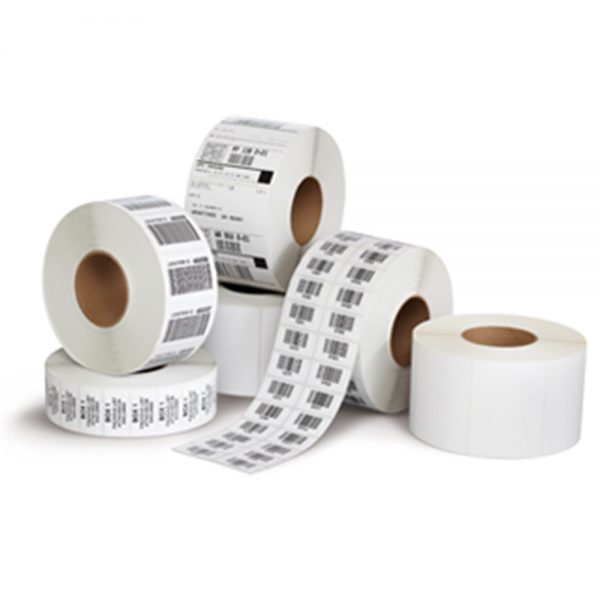
Direct Thermal Printer Labels use a well-established technology common in till receipt printers, older fax machines and point of sale terminals. The printing system works by activating a pigment present in the paper rolls used in the printer. Direct Thermal printer labels work by having the pigment ‘cure’ and change colour when heat is applied. Direct thermal printer labels have the advantage of requiring no inks, toners or ribbons. The printers themselves can be compact and lightweight too so many practical applications exist. They can also be built for industrial use due to their reliability and capacity to do long print runs.
Direct Thermal Printer Labels Usage
This print technology is ideal for situations where labels will not be exposed to harsh environmental conditions and where the label lifespan is a matter of months. Of course, the harsher the environment, the shorter the durability in any case.
The technology is not suitable for wet or high humidity environments, hot environments or high UV environments (i.e. exposure to direct sunlight for prolonged periods). A similar system using so-called thermal transfer is a parallel technology for such circumstances and idea for chemical labelling.
Direct Thermal Label Printers
The direct thermal printer print head has a series of tiny ceramic print heads. These can be heated and cooled very quickly which in turn heats the paper passing under the print head. The thermal paper is passed under the print head at a constant and known speed, perpendicular to the print head. In turn, each ceramic head can be switched on and off (i.e. pulsed) to heat and cool for different lengths of time. The result is individual dark lines recorded in the material to create an image or text. Therefore, if all the ceramic discs are heated simultaneously, the paper can be turned from white to black.
Resolution
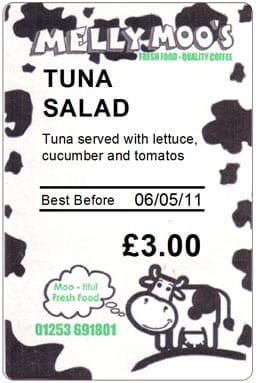
A direct thermal printer will commonly come with 200 ceramic discs per inch of print head – this is referred to as dots per inch or dpi – in other words, the resolution. 200dpi resolution is perfectly suitable for receipts, courier labels or sandwich labels.
Printers are also available in 300 and 600 dpi versions should a higher resolution be needed. 300 dpi versions are about twice the price of 200 dpi versions. 600dpi versions are twice as expensive again.
Print Speed
As well as expense, generally speaking, the more dpi a printer has, the slower it will work. 200dpi printers can run at up to 14 inches per second (350mm/sec). 600dpi printers will struggle to muster themselves past 3 inches per second. As with most technologies, compromises are part of the solution.
Print Width
Printers come in a range of print widths. Commonly 2,4,6 and 8-inch print heads are used with 8 inch being capable of printing A4 in portrait mode and useful for odette labelling or A4 parcel labels.
In terms of cost, prices kind of double with every factor that is increased. The wider the head, the more the cost, the faster the head the more the cost, the higher the resolution, the more the cost. You can’t have high speed and high resolution so generally, A4 laser printers are often a better technology to turn to for high-speed high resolution, low cost.
Direct Thermal Paper
Direct Thermal Printer Labels use paper prepared by having a colourless pigment applied to it which solidifies as a crystallised matrix with an organic acid. This pigment and acid is stored in a solid form but has a relatively low melting point. When the pigment crystals melt from the heat of the print head, they react with the acid which changes the pigment’s molecular structure, changing its colour. The pigment then re-solidifies in that form. This process is known as tautomerization.
Pigments have now been developed in a range of colours but the tautomerization process is the same irrespective of colour. As a result, labels can be manufactured to have certain areas change to specific colours. These cannot be combined to create full-colour images in this specific industrial printing process. Using single colour direct thermal printer labels, it is not possible to print a photograph in full colour but a black and white rendition can be quite satisfactory.
On a side note, Kodak developed a full colour system in the late 1990’s caling “Zero Ink” or Zink for trademark purposes. This is used specifically in instant cameras and not suited to industrial printing.
Eco v Semi-Top Coat
Whilst ‘eco’ direct thermal printer label paper will not have a specialised coating applied to the top of the material, premium grade material will. This has a number of benefits.
Reduced fading of material after printing
Acts as a lubricant for the print head giving smoother performance, reduced wear and longer print head lifespan
Reduced transfer of coatings from paper to print head giving better output and less need for cleaning
Targets the heat to the pigment layer for darker, crisper print
Provide a key for overprinting plain labels with ink i.e. pre-printing
In some cases, the surface coating can provide better water and oil resistance for the labels although this is marginal.
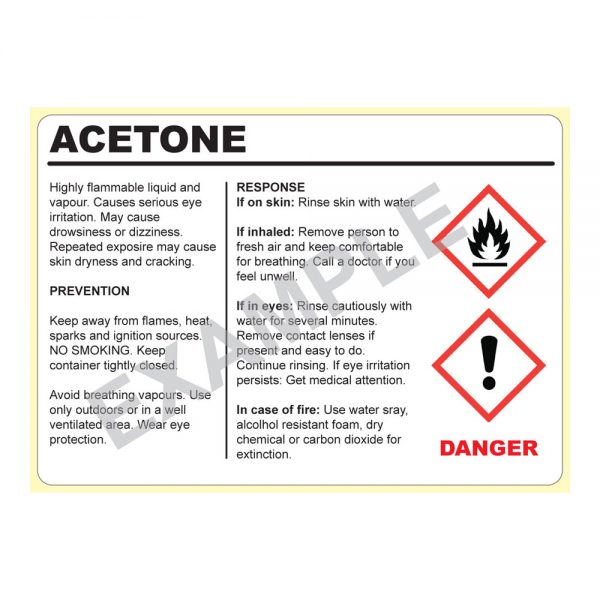
You can buy any sort of direct thermal printer label from Positive ID Labelling and we produce a wide range of labels for specific uses in the food and chemicals industries. For more information on buying direct thermal printer labels, call us on 01332 864895 or fill in the enquiry form below:
We can design, print and deliver your labels and stickers within 1 week of your order, so you can ensure your products look amazing as quickly as possible.
Expertise and Knowledge
Customer Focus and Trust
Speed and Efficiency
Diverse Product Range
Last year Freezeland Ltd, a London based retailer of frozen products, contacted us regarding their labelling. Here at Positive ID we are proud to announce that we completely revamped their labelling process. We now supply them with 70,000 labels a year for them to use on their desktop printer system.
Freezeland Ltd
The result is a clearly read label giving all the details necessary. Jackie Harris, Technical Manager at Plants Plus explained that Positive ID Labels labelling solution has speeded up the labelling operation by more than 50%, with a significant cost saving. “It’s ideal for our business,” she said.
Plants Plus
Orexis Fresh Foods Ltd is a family run Food Manufacturing Company specializing in ethnic dips, Mexican dips, luxury salads and sandwich fillings. Orexis Ltd approached Positive ID for a simple cost effective way to apply a “Best Before” and “Batch Number” to a range of their products.
The answer was to use a two line-labelling gun. George Katsaros from Orexis said “we have been using Positive ID for 3 years now and they initially advised us correctly about the right products to use and have been well pleased and served by them since”.
Orexis Fresh Foods
Samantha Gore from Samsi was particularly pleased that we met all the deadlines and she described the experience as ‘fun’ and stated that all staff from Positive ID were very friendly and happy to help. Also, she thanked us for our patience with all the refinements she desired.We are proud to hold great relationships with all of our customers and look forward to many other stories like this in the near future.
Samsi
Contact Us
Get free advice from one of our print experts by calling: 01332 864895 or fill in your details below.












 Expertise and Knowledge









 Customer Focus and Trust
  Speed and Efficiency
  Diverse Product Range
  Advanced encryption keeps your data safe and secure